Showing posts with label Derwent. Show all posts

Saturday, 23 March 2013

Derwent announces NEW helical pencil sharpeners

I'm a huge fan of pencil sharpeners with helical blades.  These are the ones which have a helical blade - that's the one where the cutting edge of the blade spirals around a core.  The reason I like them is because they cut cleanly, efficiently and very effectively.  The best points I've ever got have been produced by a pencil sharpener with a helical blade.

Three years ago Derwent produced a battery powered helical pencil sharpener which I did not recommend.  There were just too many problems (see (Product review: Derwent Battery Operated Helical Pencil Sharpener) 

However having been through that experience, I know they were working hard to understand why the problems had occurred.  As a result, although I've not see one yet, I'm confident that this next batch will be much better.  This time they've kept the helical blade but gone for the old fashioned hand crank rather than batter power.

NEW Product - Derwent Helical Pencil Sharpener - Super Point and Super Point Mini
I've not seen one yet.  This is what you need to look out for.
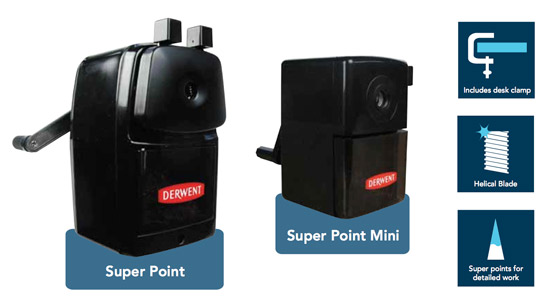
NEW! Derwent Helical Pencil Sharpener - Super Point and Super Point Mini
(note the hand crank i.e. NOT battery powered)

Features and Facts

Features common to both sharpeners

  • each sharpener has a durable helical blade.  This SHOULD enable you to sharpens pencils to fine points typically used for fine detail work.
  • both sharpeners can take pencils up to 8mm in diameter 
  • Shavings are collected in a transparent sliding tray reservoir.  Derwent says this is easy to empty. 
  • each sharpener comes with a desk clamp.
  • both pencil sharpeners come with a hand crank (the old ones had battery power)
I haven't got a clue what this mean "The extendable front plate has a self feeding mechanism which stops when the pencil has reached a superb point." as there are no photographs to demonstrate.  I think it means it has an auto-stop.


Super Point Manual Helical Sharpener

  • made of black metal which makes this both heavier and more robust
  • Super Point costs £21.95
Super Point Mini Helical Sharpener
  • lighter and a more compact shape
  • Super Point Mini costs £14.95

Beware of trying to buying these sharpeners on Amazon.  
  • The ones listed at present are the battery powered versions which I covered in my review - which simply are not reliable and do not work well.  
  • Look for the date the battery was introduced.  If it's not 2013 then it's one of the old ones.
Product reviews of Pencil Sharpeners

Below you can find my product reviews of pencil sharpeners.  I tend to err towards only reviewing products that I either do or do not recommend.

Monday, 18 February 2013

The Favourite Coloured Pencil Awards! (2012 Brand Poll Results)

This is my Annual Report on the results of the Annual Poll which asks which is your current favourite brand of artist grade coloured pencil.

Artist grade in this connection means:
  • used by fine artists (whether professional or amateur) - people who would like their artwork to last and/or to sell it.
  • suitable for fine art rather than commercial art where longevity is of no relevance once the artwork has been photographed.
Below is the chart of the results from the Annual Poll on my resource website Coloured Pencils - Resources for Artists (VOTE on this 2013 Poll by clicking this link - 2013 POLL: Which is the best brand of artist grade coloured pencil?)

Chart of the Results of the 2012 Poll:
Which is the best brand of artist grade coloured pencil?
This year 347 people voted during 2011 to determine which is the best brand of artist grade coloured pencil.  This is fewere than in previous years but I didn't remind people about the poll at mid-year as I've done in the past.

The results are as follows
  • The Favourite Artist Grade Coloured Pencil in 2012 - Faber Castell Polychromos (33.4%)
    • 2nd - Sanford Prismacolor Premier (15%)
    • 3rd - Derwent Coloursoft (8.4%)
    • 4th - Caran d'Ache Luminance (6.6%)
    • 5th - Caran d'Ache Pablo (5.5%)
  • The Favourite Lightfast (6901) Artist Grade Coloured Pencil in 2012 - Caran d'Ache Luminance (this is a pencil which is accredited as being compliant with the standard ASTM D-6901 for testing Lightfastness in Coloured Pencils created by the American Society for Testing and Material).
  • The Favourite brand of Artist Grade Coloured Pencil Media in 2012 - Faber Castell Polychromos - by a mile!
Which means Faber Castell is now the dominant brand and Polychromos is the dominant artist grade coloured pencil within the coloured pencil marketplace for fine artists.  

For a further explanation of how this comes about see below.

Analysis of changes in coloured pencil brand preference over time

It's worth remembering that the performance of different pencils in Opinion Polls is highly dependent on how easy they are to obtain and the patterns of buying behaviour in different countries.  

What I have found noticeable over time is that as more people buy online they are more likely to try new brands of pencils - and are no longer dependent on the pencil in open stock at their local art store - assuming that this store has survived the recession!

The recession has also inevitably had an impact.  One might expect the cheaper pencils to be doing better.  In fact the reverse seems to be occurring and those with more disposable income seem to be favouring the top quality pencils - even if they are more expensive.

Changes in coloured pencil brand preferences 2008 - 2012

I've been running the Poll since 2008 so it's developed a few trends in that time - and we'll look at these below.

CLICK THE CHART below to see a MUCH LARGER version of this chart which shows the percentage share each manufacturer earned in the annual polls.  The very minor brands have been eliminated from view in the chart for the purposes of this analysis.


  • GAINERS: Faber Castell, Caran d'Ache
  • LOSS OF SHARE: Prismacolor, Lyra Rembrandt
  • NEUTRAL: Derwent, Blick and Talens Van Gogh
The Annual Poll was started partway through 2008.  The pattern over time, based on the poll results for the last five years, can be summarised as follows:
  • There have been three dominant brands in the marketplace in the last five years - Sanford Prismacolor, Faber Castell Polychromos and Derwent (various)
    • Two more brands Caran 'Ache and Lyra Rembrandt have been competing for attention - and one - Caran d'Ache - is beginning to have a serious impact in 2012.
    • There are two minor brands - Talens van Gogh and Blick
  • In 2012, there has been a significant shift
    • Faber Castell is now dominant over the combined pencils of all other manufacturers. 
    • One pencil - the Polychromos - now has a 1/3 share of the market.  It is more than  twice as popular as its nearest competitor.
    • Prismacolor has lost 45% of its market share in the last year - and is no longer rated as the premier brand of coloured pencils.  For the last four years it has consistently had just less than a third of the market (28-32%).  This year its share has reduced to 18%.  (I'll comment on this further)
    • Derwent and Prismacolour are now neck and neck in the popularity stakes
    • The Caran d'Ache Luminance pencil - which is lightfast - has continued to build its share of the market DESPITE being the most expensive coloured pencil in the world!  This very clearly demonstrates that price is obviously NOT a barrier to building market share amongst fine artists if people want a quality pencil which is lightfast.  It comprehensively demonstrates that any failure of previous brands of lightfast pencils (which have been dropped) is very probably down to:
      • the quality of the pencil in terms of application and use 
      • the marketing of the product
      • and/or both the above!
While there may be weaknesses in my poll results, so far as I am aware there is no other consistent polling of preferred brands of coloured pencils on a global basis.  If there is I'd be happy to study the results and any inconsistencies with the results of my poll.  (I used to crunch numbers and analyse them for a living!)

Conclusion

The following summary is a product of both the poll, consumer comments available on the Internet (and offline) and recent research.

To my mind the current situation can be characterised as follows.
  • Faber Castell has been very focused around the quality of one pencil.  It delivers a high quality product of consistent reliability.  This has earned the Polychromos many admirers - who in turn recommend the pencil to others!  This focus on one pencil gives it a much bigger impact in the marketplace.
  • Sanford has lost its way both in terms of  product range, its target market and the quality of the product produced.  I have observed lots of changes and no discernible direction in strategic terms plus lots of complaints about matters which the company has failed to address over the years. It no longer feels to me like a manufacturer which is serious about producing quality products for fine artists.  Its cheap unreliable pencil appears to be targeted at the younger / student market and children and adults who like colouring pages.
  • Derwent has a huge range of pencils - none of which do particularly well - apart from the Coloursoft.  Effort and marketing appears to be spread thin.  They could have had the lead in the Lightfast Pencil market - and abandoned it.  Issues around lightfastness continue to be relevant to the artist grade range.
  • Caran d'Ache is playing a blinder.  It took time to produce a well thought out pencil which has become very popular - the Luminance.  Despite its high price, this pencil is attractive, works well and is readily available - it looks likely to continue to be very popular and to grow its market share over time.  Not least because it is certified as ASTMS 6901 compliant - and is the only leading artist grade pencil which can claim this. Its growth has also not seriously dented the market for the Pablo Pencil.  The company persuade me (and others) that they recognise how long it takes a new product to establish itself in the market and have a focus on continuous improvement.
Thus we have my personal 'take' on four manufacturers who all demonstrate a very different approach to how to win share and make money from coloured pencils.  

While fine artists are only a small part of the coloured pencil market as a whole one is led to wonder why more artist grade pencils don't emulate the success of the Polychromos!

I'm going to follow up this Poll Report with in-depth analysis of the main brands.  I have eclectic tastes rather than being a dedicated fan of one brand - so this should prove interesting.

I've started by updating the analysis of brands in the Artist Grade Coloured Pencils: Brand Information section of Coloured Pencils - Resources for Artists.  Each of the sections on the manufacturers of artist grade pencils now has a section which covers:
  • SUMMARY
  • Favoured by
  • No. of artist-quality coloured pencils 
  • Meets 6901 Lightfastnes Standard
  • Characteristics of coloured pencils
  • Pencil equipment/aids available? 
  • Characteristics of Manufacturer
  • Country


Do SUBSCRIBE
if you'd like to be kept informed about the other Poll results for 2012 
and/or reviews of art products and art books in 2013. 
You can find a subscription link near the top of the side column.

Links:

Wednesday, 7 March 2012

Derwent Carry-All (product review)

This is a preliminary review of the NEW Derwent Carry-All which I have yet to take out with me.  This review relates to what it comprises, how it's made and what I can and cannot get it in it.

Derwent Carry-All
(left) front view with shoulder strap attached
(right) opened up showing web pocket for accessories and pencils in a "leaf"; 
space for sketchbook is underneath the pencil leaves
(note: it doesn't come with any art materials - it's just a very big empty pencil case on a strap)

I think the Carry-All has distinct potential but for me it's a "near miss".  I'm awarding it a B+ for a good effort but could do better. 

The reason why?  Two reasons
  • I'm confused as to who it is for
  • My personal preferences for what I need - I think I would have been tempted to use it an awful lot more - and hence liked it a lot more - if it had just been 25mm taller.  I'll explain why.
I think the dimensions for this carry-all probably started with 'the pencil'. In that context it’s size makes complete sense as it’s well set-up for carrying pencils and I can imagine it will be a very useful bit of kit for those attending classes and workshops.

However if you started from the perspective of who else might want to use it then I think Derwent might well have given some more thought to the size.  It’s not big enough to take an A4 sketchbook or most panoramic sketchbooks so one’s limited to carrying an A5 size sketchbook or a smaller Moleskine sketchbook.

The size aspect is what’s going to limit my use of this holdall.  I was ever so disappointed as I tried every which way to get my A4 sketchbook into it.  That's because if I'm using a smaller sketchbook I then also downsize how many pencils I carry around with me.  I can get a small sketchbook and mini pencil wrap in my handbag.  (see Making a Mark Reviews: Product Review: Derwent Pocket Pencil Wrap 24 May 2010)

Here's the breakdown of what I found.  I'll also report back once I've used it 'in the field'.  I'll also be asking Derwent about the size issue as the Carrry-All I have is nothing like the dimensions on their website.

Product: Derwent Carry-All
Summary Review: It's a well-made rather large pencil holdall on a strap.  I find this product promising but confusing. I’m not clear who the target consumer of the carry-all.
  • Storage emphasis: It’s great for people who want a good way of keeping their pencils and other bits of kit neat and tidy and all in one place at home.
  • Mobile with pencils: It’s great for those who just want to carry a lot of pencils and a bit of extra kit around from A to B without lugging a great big pencil box or tin around. However if that’s all they want to do then I’m puzzled as to why the Derwent pencil wraps - which take 30 pencils each - would not work better?
  • Sketching: HOWEVER It’s undersized for the serious sketcher and oversized for a small sketchbook or anybody with a more minimalist approach.  If this bit were fixed it would still serve the other two pencil uses equally well.
Technical Details: The Derwent Carry-All is described as “a pencil storage solution” with the scope to store “up to 132 pencils and more”.
  • size: the product details tell me it should measure 8" square and 6.5" deep (220mm x 220m x 170mm) which would make it an ‘almost’ cube. HOWEVER the one I’ve got is 220mm wide, 275mm high and 130mm deep - so I’m now wondering if there are different sizes. (Mine is 25mm short of an A4 sketchbook - very frustrating!)
  • material: made of a sturdy grade of fawn canvas (same as that used for the pencil wraps); the trim is dark brown. Feels robust.
  • strap: optional shoulder strap in fawn/dark brown canvas. The strap clips are diagonally opposed and not fixed to the centre of each side as that’s where the zip goes. I’d have liked a more padded shoulder grip
  • hand grip: comfy padded carrying handle/grip with velcro fasteners (if not using strap)
  • pencil storage: product details say it comes with 3 pencil “leaves”; each one is supposed to be capable of holding 44 pencils. Mine came with just 2 leaves and I think I can get 24 pencils in each side (2 per elasticated slot) making 48 pencils per leaf and 96 pencils in total. I guess the scope to hold “up to 132 pencils” is related to the three leaves it’s supposed to come with
  • exterior pocket with velcro tab
  • Interior web pocket - big enough for incidentals (erasers, sharpeners, viewfinder etc)
  • Interior elastic band - looks as if was designed for a very fat sketchbook. Too big to hold my Moleskine secure.
Who should buy this?
  • people who sketch (but work out when you’d use it first)
  • pencil artists needing a neat storage solution for the home
  • pencil artists attending workshops
  • suitable for all makes of coloured pencils - I tried them all!
Who should not buy this?
  • people who like big sketchbooks
Highlights:
  • appears to be robust materials and well made
Think Again?
  • decide first what method of transporting pencils works best for you and your own personal needs
Manufacturer / Distributor: Derwent / Cumberland Pencil Company
Suppliers:

Interestingly it's also big enough to take an iPad - but then if I was sketching with my iPad I wouldn’t need the pencils! :)

Sunday, 8 January 2012

The Favourite Coloured Pencil Awards! (2011 Brand Poll Results)

577 people voted during 2011 in the 2011 POLL: Which is the best brand of artist grade coloured pencil? to determine which is the best brand of artist grade coloured pencil on Coloured Pencils - Resources for Artist.

The results are as follows
  • The Favourite Coloured Pencil in 2011 - Faber Castell Polychromos
  • The Favourite Lightfast (6901) Coloured Pencil in 2011 - Caran d'Ache Luminance (this is a pencil which is accredited as being compliant with the standard ASTM D-6901 for testing Lightfastness in Coloured Pencils created by the American Society for Testing and Material.
  • The Favourite brand of Coloured Pencil Media in 2011 - Sanford Prismacolor
Which means "no change" from last year.  At the end I've got a table which show the changes between 2009 and 2011.

Below are the results of the poll.

Which is your current favourite brand of artist grade coloured pencil?
2011 Opinion Poll from Coloured Pencils - Resources for Artists

577 artists voted in 2011 (compared to 760 artists in 2010 compared to 792 in 2009)

The emphasis of the poll is at looking at your CURRENT FAVOURITE coloured pencils.  This is on the basis that each year brands are upgraded, new products are introduced and coloured pencil artists try new pencils - and they can change their mind about which pencils they like to use best.

Below you can see how market share has changed in the last two years - according to those who respond to this poll

(Note - this poll/chart/table in now way suggests this is totally accurate about real market share - but the sample size is such it's very likely to a good indicator)

Indications of Coloured Pencil Manufacturer's market share according to 2011 Poll

Coloured Pencil Manufacturers                    (all brands) 2009 2010 2011 Increase / (decrease) 2009 to 2011
% % %
Sanford Prismacolor (all brands) 29.4 32.6 32.8 3.4
Faber Castell Polychromos 27.3 26.4 27.4 0.1
Derwent ( all brands) 22.5 21.3 17.7 -4.8
Caran d’Ache (all brands) 10.4 10.7 7.9 -2.5
Lyra Rembrandt 7.2 4.2 9.7 2.5
Royal Talens van Gogh 2.0 2.8 1.9 -0.1
Blick Studio Artists 0.0 2.0 2.4 2.4
Pantone 0.2 0.2
98.8 100.0 100.0 1.2

  • GAINERS: Sanford Prismacolor, Lyra Rembrandt and Blick
  • LOSS OF SHARE:  Derwent, Caran d'Ache and Talens van Gogh (latter is no longer available in the USA)

Both Faber Castell and Sanford Prismacolor are maintaining their position from last year, while Sanford has now established that the recovery in 2010 was no 'flash in the pan'.

Dick Blick is doing reasonable business with their new pencils - which are thought to be made by Koh-i-Noor

Caran d'Ache Luminance appears to be maintaining its popularity with those who want accredited lightfast coloured pencils - despite the price.  However the popularity of their Pablo pencils has diminished.

With Derwent, the Coloursoft brand is holding up well with the Artists and Studio Pencils (which have both been around for a very long time) losing some ground.

The probable explanation for the drop in the Talens Van Gogh drop is almost entirely accounted for by the fact they are no longer exported to the USA and hence are only available there is you order them from Europe.  For some reason they keep being described as "discontinued" in the USA (even on the CPSA website!).  There's a lot of difference between "discontinued" and "no longer available in the USA"!  I just did a very quick search online and found them on the iartsupplies website.


Do SUBSCRIBE
if you'd like to be kept informed about the other Poll results for 2010 

and/or reviews of art products and art books in 2011. 

You can find a subscription link near the top of the side column.

Thursday, 17 March 2011

Product Review: Derwent Black Book

Derwent Black Book (A4 size)
Coloured pencils have a reputation for sinking into black paper over time - which is a bit of a nuisance to put it mildly as this can alter the value pattern of any artwork you produce!

Derwent sent me one of their Black Books to review a while ago.  I've been waiting a while to check out the impact of black paper on my coloured pencils. Below you can now read my review.

Product:  Derwent Black Book
Summary Review:  This is a black paper sketchbook.  The stiff 200gsm paper is suitable for dry rather than wet media.  I very much liked the surface and it's easy to take an eraser to it without abrading the surface.

In terms of colour, woodless pencils such as my set of Caran d'Ache Neocolour worked better than colours from a range of brands.  Watersoluble pencils are useless on this paper as tints are totally invisible.  Some colours sink into the paper or are distorted due to its colour.  Others appear more muted.

In my opinion, it's a sketchbook which is very suitable for use with colours which retain brightness and saturation on this paper - which not all do (see colour charts).  Having said that it's no worse than any other black paper.  Selective use of certain colours will create images with impact.
Technical Details: The Derwent Black Book is a black paper sketchbook. 
  • Available in 3 popular sizes A3 landscape, A4 portrait and Square (12” or 30.5cms)
  • each one contains 40 sheets of 200gsm black paper (which means it's stiffish)
  • heavy weight paper which does not abrade easily and can take a lot of layers of coloured pencil
  • Derwent states it can be used with water soluble pencils for light washes.  (Which means it's likely to buckle if you do any more than that)
Who should buy this?
  • artists interested in drawing and sketching on black paper
  • people interested in flexing their approach to creating a coloured drawing
Who should not buy this? 
  • those who don't like coloured paper
Highlights:
  • sturdy paper with a very smooth surface
  • accepts coloured pencils and waxneocolour crayons well
  • certain colours pop (while others are suddued)
  • sturdy ring binding - gives the sense of lasting a long while and NOT getting annoying
Think Again?
  • the black paper mutes the colours of ordinary artists' coloured pencils 
  • some colours 'sink' over time (a common problem with black paper)
  • some colours do not display 'true' eg yellow takes on a greenish tinge (true of very many black papers)
  • it's useless for watercolour or dispersing watersoluble coloured pencils/crayons.  Tints disappear.
Manufacturer / Distributor:  Cumberland Pencil Company (product page)
Suppliers: 

  • supplied to me as test item to review;
  • available from Derwent retailers
  • Online Retailers include: Heaton Cooper; Artifolk

Derwent have a small range of sketch books which contain stiffish black paper.  Each sketchbook has 40 sheets of 200gsm black paper, which means it's a weight which makes it similar to thin card.  There are a good range of sizes which offer an opportunity to do larger work.  

I tried it with a range of coloured pencils from different brands and with Caran d'Ache Neocolour.  I had a suspicion they might work better with wax crayons - and they do.

Of the charts below the first one is coloured pencils and the second one is neocolour.  After that there are a couple of sketches made using (1) coloured pencils and (2) neocolor crayons.

Coloured Pencils from various brands
In my view, some of the colours have "sunk" over time.  Others continue to appear muted.  The white (bottom right) is actually a white charcoal pencil.

The next chart is of neocolor crayons which to my mind work a lot better.

Chart of Neocolor II Aquarelle Artists' Crayons
Neocolor II Aquarelle Artists' Crayons have a high pigment concentration and seem to work much better on this paper.  I tried wetting the ends of the colour bars to see how a tint might look - and you can see the results.  You can't see anything!  Basically black paper is not suitable for washes or tints - they simply won't show up!

Now for the sketches to see how the colours work together on the paper.  I would say that working on black paper means adapting to a new way of working where the darks are supplied largely by the paper.

First the sketch with coloured pencils.  As you can see the whites look grey - and I tried several!  hence why I ended up using the whitest white I know which is the White Pastel Pencil.

Hertford Union Canal
Coloured Pencils in Derwent Black Book
copyright Katherine Tyrrell
I wouldn't exhibit this as overall the colours are just too muted - as found with the colour chart.  However note how effective working back into the sketch with an eraser is for picking out the lowlights.

Next a sketch using the necolor crayons.  This I think demonstrates how well the paper works if you go with big shapes, bold colours, a calligraphic way of working - and again work back into it with an eraser to find the darkest darks

Schönbrunn Park (after Klimt)
Caran d'ache Neocolour in Derwent Black Book
copyright Katherine Tyrrell
Overall a book I've been interested to try and one which I will doubtless continue to try in terms of finding what works well with it.

The black paper is very nice - if you accept its limitations.  Expect to see more experiments in the future!

Links:  Watermarks - Schönbrunn Park - after Klimt

Sunday, 2 January 2011

The Favourite Coloured Pencil Awards! (2010 Brand Poll Results)

760 people voted during 2010 in the 2010 POLL: Which is the best brand of artist grade coloured pencil? to determine which is the best brand of artist grade coloured pencil? on Coloured Pencils - Resources for Artist.

The poll is now closed and below you can find the results

Having studied the results I've split the favourites into three different categories
  • The Favourite Coloured Pencil in 2010 - Faber Castell Polychromos
  • The Favourite Lightfast (6901) Coloured Pencil  in 2010 - Caran d'Ache Luminance
  • The Favourite brand of Coloured Pencil Media in 2010 - Sanford Prismacolor

Which is your current favourite brand of artist grade coloured pencil?
2010 Opinion Poll from Coloured Pencils - Resources for Artists

Key points:
  • 760 artists voted during  2010 compared to 792 in 2009
  • in 2010 the different brands of pencil were disaggregated under each manufacturer
  • Prismacolor appears to be ahead of Faber Castell as a brand leader - however 10% of that lead is accounted for by the woodless coloured pencils Art Stix (which are also marketed to pastel artists)
  • the favourite brand of coloured pencil is Faber Castell Polychromos
  • the favourite brand of Lightfast coloured pencil is Caran d'Ache Luminance
You can see the 2009 results below and in Two new coloured pencil opinion polls for 2010 which has a chart for the previous poll


Coloured Pencil Manufacturers (all brands) 2009 2010 Increase / (decrease)
% %
Bruynzeel 1.1 0.0 -1.1
Blick Studio Artists 0.0 2.0 2
Caran d’Ache (all brands) 10.4 10.7 0.3
Derwent ( all brands) 22.5 21.3 -1.2
Faber Castell Polychromos 27.3 26.4 -0.9
Lyra Rembrandt 7.2 4.2 -3
Sanford Prismacolor (all brands) 29.4 32.6 3.2
Royal Talens van Gogh 2.0 2.8 0.8
99.9 100.0 0.1
 
Note:  There's a rounding error in the 2009 total

Commentary

Most of the percentage changes are minor apart from those relating to the smaller brands.

I'm hoping nothing happens to Lyra Rembrandt which is one of my favourite brands of pencils.  They mix extremely well with Faber Castell Polychromos

Caran d'Ache Luminance (6901) appear to have succeeded in capturing significant market share where previous brands of lightfast pencils to the ASTM 6901 standard have not.  This is despite being the most expensive coloured pencil on the planet!

I'm guessing here - but I do wonder whether the significant presence of Art Stix in the 2010 Poll may be due to one or more of four factors and significant changes in the way coloured pencil media is laid down
  • easier to use for those wanting to use solvents with their coloured pencil media
  • easier to use for those wanting to use heat with their coloured pencil media
  • easier to use for those working on larger pictures
  • multiple marketing - they are also bought by pastel artist
    Do let me know what you think by leaving a comment below.

    Do SUBSCRIBE if you'd like to be kept informed about the other Poll results for 2010 
    and reviews of art products and art books in 2011.  
    You can find a subscription link near the top of the side column.

    Thursday, 11 November 2010

    More about Lightfastness

    As manufacturers begin to appreciate that lightfastness does matter to artists, we're beginning to see more and more information published by those that make the art materials we buy

    I just want to highlight today a couple of examples:
    • the new Love Pencils - the Derwent blog created by the Cumberland Pencil Company has a post Lightfastness Testing Revealed!  about how they test for lightfastness
    • Schminke - who make pastels I use - have a two page leaflet about the processes they use when creating art materials (see lightfastness.pdf available to download as a pdf file).  In it you can see an example of the blue wool cards used as a quality control by many companies manufacturing art materials.  This gives you a very good display of just how much fading happens in those actually graded 'lighfast' at levels 5 and 6 - and just how much disappears at the lower end of the scale.  
    Seeing real blue wool cards like this - and how dramatic the fading can be - is what woke me up to the cause of lightfastness.  I now aim to use only pencils which meet levels 7 and 8 (ie 4 star and 5 star pastels and pencils).

    Extract from Schminke Leaflet - Lightfastness – A Measure of the Durability of Artists’ Colours (pdf file)
    I also learned something new from the Schminke leaflet and that is lightfastness levels MUST always tested on the finished product as the mediums which combine with some pigments can result in colours which darken.

    You can read and learn more about lightfastness on two of my resources for artists sites:

      Monday, 24 May 2010

      Product Review: Derwent Pocket Pencil Wrap

      I've been testing the Derwent Pocket Pencil Wrap and have to say I'm very impressed. It's rapidly becoming a favourite bit of kit for a minimalist approach to sketching. As you can see from the photo it's become very well used very quickly! The solution to the marks on the canvas - which bother me not one jot - is to turn the pencil the other way round as shown in the packaging. I just prefer to have my pencil points up top!

      I'm an inveterate buyer of pencil cases and pencil wraps - I'm always trying to find 'the perfect one'! I also had Derwent's bigger pencil wraps for more pencils so was familiar with the product and was keen to try this new version out - as a potential solution to the 'what do I take when I only want a few pencils and a small sketchbook in a pocket?' question

      The pocket pencil wrap was launched in March and you can find my review below.

      RECOMMENDED Product: Derwent Pocket Pencil Wrap
      Summary: a canvas wrap which holds up to 12 pencils and pens. Suitable for slipping in a pocket with a small sketchbook
      Technical Details:
      • made of a very sturdy grade of canvas
      • leather look edges
      • folds in two and fastens with a velcro fastening
      • capacity for 12 Derwent pencils or alternates
      Who should buy this?
      • artists who sketch
      • artists who like putting all their sketching kit inside their jacket and trouser pockets - like David Hockney - will love it!
      Who should not buy this?
      • artists who never take their pencils outside their home
      • artists attending a coloured pencil workshop (only because you'll likely want to take more than 12 pencils and there are bigger pencil wraps!)
      Highlights:
      • thick canvas wrap helps protect pencils
      • flap over pencils helps keep them safe and stops them falling out. You don't need to worry which way you put it in a pocket
      • compact size makes it very easy to take pencils out; very easy to slip inside a jacket or trouser pocket or small bag
      • velcro fastening works well so long as you don't overfill the pencil wrap
      Think Again?
      • pencils mark canvas if points are uppermost - it doesn't bother me at all. If it is likely to bother you then the simple solution is to invert the pencils
      • also of interest to people who want to take any sort of drawing implement out of their studio - it doesn't have to be a pencil!
      • it does NOT come with pencils
      Manufacturer / Distributor: Cumberland Pencil Company / Derwent
      Suppliers:
      • supplied to me by Derwent as an item to review;
      • available from Derwent retailers. Online Retailers include: Heaton Cooper; Artifolk


      Art Equipment - Resources for Artists
      Art Equipment -  Resources for Artists


      This site is for visual artists. It provides links to: items of art equipment and tools recommended ways of putting together toolkits and recommendations for equipment for working in the studio or plein air

      Thursday, 11 March 2010

      Product review: Derwent Battery Operated Helical Pencil Sharpener


      Derwent Battery Operated Helical Pencil Sharpener

      Product: Derwent Battery Operated Helical Pencil Sharpener
      Summary: I've tried two and neither have worked properly. I've also heard from a fair few fellow pencil artists of various degrees of experience who have also tried this sharpener and also had problems. I'm not happy and I know Derwent is trying to find out why the problems are happening. This is NOT a recommended purchase.
      Technical Details:
      • 11cm(w) x 7.5cm(h) x 6.4cm(d)
      • it's not light - it takes 4 AA batteries
      Who should buy this? A difficult question. In principal, it has the scope to be an ideal pencil sharpener for those wanting to be able to transport a helical pencil sharpener outside the home or studio (eg to class or into the field). On the other hand it's not that light or compact and the problems with usage suggest it might be better to wait until Derwent have at least got the latter fixed.
      Who should not buy this? Anybody wanting a needle sharp point quickly and every time they insert a pencil. The best bet for this is a mains powered helical sharpener.
      Highlights:
      • velvet feel black plastic
      • looks neat
      • stable with rubber feet and weight of the batteries
      Think Again?
      • hole does not seem to like the larger Derwent pencils
      • very difficult to detect the polarities for the batteries
      • not a particularly lightweight portable sharpener with four AA batteries in place
      • shavings receptacle fits neatly but does not click into place - which always worries me
      • poor track record in terms of ones I've tried. One didn't work and the second couldn't produce a sharp point (see picture below)
      • expensive (recommended retail price is two thirds that of a mains powered heavy duty helical sharpener with thermal cut out!)
      Manufacturer / Distributor: Derwent Retail price: £19.99
      Suppliers: various eg Artifolk (16.99)

      I've held off from reviewing this sharpener for a while as it was new to the market and there seemed to be some teething problems. However I'm continuing to hear about people who are having problems with this sharpener (notably one tutor who got several for a class and then found that 10 out of the 12 were faulty in some way) so I've decided it's about time I did a proper review.

      It's not good news.

      The first one sent to me for review by Derwent failed to work at all and had to be sent back. I spent ages inserting the batteries, trying them in diffierent configurations, finding a different set of batteries, repeat as before etc etc. It was very frustrating but Derwent were very helpful and sent me another one to review.

      The design and practical issues that I noted at the time (quite apart from the fact it didn't work were as follows.
      • Batteries:
        • The batteries required are described as 4 x 1.5V AAsize UM3 batteries. I've never heard of UM3 batteries. Google suggests they are batteries used in the USA. The standard batteries that I use for virtually all my needs are always described as AA LR6 batteries.
        • Design wise, the polarities information relating to inserting the batteries correctly is a lot more difficult to detect than on alternative brands of battery powered sharpeners. You need a very good light to see them on the inside of the battery cabinet (ie black on black in a dark space!). Finally I also found them on the underside of the lid of the battery cabinet - which is not where the leaflet says they are.
        • I gather there has been some suggestion of 'battery-related' problems but I don't know whether this is due to people not using the right batteries, not being able to work out how to get them in correctly or just bad connections I don't know. What I do know is that there are too many different ways of failing to get the batteries to operate properly!
      • Shavings bin: The shavings receptacle didn't give me a lot of confidence that it would stand up to a lot of removal and reinsertion. It's only got one tiny plastic tab (very easy to break) and it doesn't have a nice 'click' when put back in place - which always worries me when there's scope to dump pencil shavings everywhere. Helical pencil shavings are also a total nightmare to clear up due the fact they are so very fine. I really like shavings receptacles which are very easy to pull out and slot back first time every time - and this one didn't. Plus being able to see easily where to slot them back makes the chances of getting it right much more likely. My view was that there's quite a lot of scope for design improvment in this area.
      • Cleaning brush: It comes with a brush for cleaning out the helical blade but I wondered at the time how long it would be before it was lost. I started off keeping it in the shavings receptacle but now can't find it! If it had a gripper (maybe underneath?) which kept it with the sharpener it would be a much more practical idea. However we've all got ready access to brushes for performing the same task so one has to question whether it's really necessary. This is already an expensive sharpener and if I were Derwent I'd be looking for ways of making it more cost competitive.
      • Size and weight - it's nice and neat if used at home. However the only real reason for having a battery powered helical sharpener is to use it out of the home and 4 AA batteries do not make this nice and light to carry around. There must be a way of creating portable battery powered sharpeners which use smaller lighter batteries! It's also more bulky than the Panasonic battery powered helical sharpener I bought from Staples in the USA which I have used as part of my sketching toolkit.
      • Instructions: Text on the instructions is completely unreadable by me even with my reading glasses. It's far too small and fails all accessibility vision tests for people with vision impairment. Lots of recreational artists are rather older and more likely to have impaired vision re reading. I'm in my mid 50s and needed a magnifying glass to read what the instructions said.
      In addition, the hole does not seem to like the larger Derwent pencils - a problem which happens often with other sharpeners but one would have thought would not occur with a sharpener that has Derwent's name on it.

      The second sharpener Derwent sent me to test worked - but wouldn't produce the very sharp point that I associate with a helical cutting blade. You can see thre results in my comparison test picture. I took two blue Derwent Coloursoft pencils and sharpened the Indigo one in the battery powered sharpener and the Prussian Blue one in the mains powered helical Jakar Electric Pencil Sharpener which I reviewed on Monday. As you can see there's quite a difference in the points achieved. The very sharp point produced by the Jakar is perfectly possible in any helical sharpener - if they work well. This one does not. Below is a picture of a test I did for this review this morning.

      Comparison: Helical sharpening two Derwent Coloursoft pencils
      (left) Indigo - sharpened using the Derwent battery operated helical pencil sharpener
      (right) Prussian Blue - sharpened using Jakar Electric Helical Pencil Sharpener - Model 5151

      It proved very difficult to get a decent fine point. When I realised how much time I was spending trying to get a point I realised that it's actually quicker and simpler to use a manual sharpener.

      The sad part of this review is that Derwent produce a lot of good quality merchandise and I'm very disappointed to be having to write a review like this. However this time Derwent seem to have commissioned a sharpener which is not performing well for a number of people. I've heard from leading artists and others to the effect that they have given up on this sharpener. It does appear to be working for some people but the sheer fact that so many people have been making adverse comments makes me think it's time for a radical rethink.

      What I would say is that Derwent were very pleased to get feedback from me about the sharpener. I told them I'd heard of similar complaints from others but did not 'name names'. So if you've got one of these and you've had problems can I suggest you get in contact with Derwent. I'd recommend using the website enquiries form and addressing your comments to Barbara Murray who is the Technical Manager at The Cumberland Pencil Company at Derwent House in Cumbria.

      What I'd like to see

      I'd love to have a battery powered helical sharpener easily available in the UK. It's not easy to find them. However I'd like to see Derwent getting their designers to address the following:
      • ideally make it a lot lighter by using batteries which are lighter if that's possible given the load requirements.
      • make it a lot more compact if targeting the portable market. It's bigger and bulkier than alternatives and hence more difficult to pack.
      • convert the batteries required to rechargeable batteries (or suggest rechargeable batteries are used). Using conventional AA LR6 batteries is going to make this sharpener an expensive proposition if this sharpener is used on a regular basis
      • make the polarities for the batteries crystal clear. Black on black is a really bad idea! My bottom line standard for this is that I should never ever have to peer and scratch my head before finding a way of shining light on the subject so I can see which way round they need to go in! Test models with people with poor vision.
      • always make sure that the shavings bin delivers a nice reassuring click when put back in place
      • make all fixing tabs of robust materials
      • make instructions easy to read
      For the record my alltime favourite for battery powered helical pencil sharpeners is the Panasonic KP 4A - see my website for comments and picture - it does the same job but is much more compact and hence I've used it a lot while travelling. Whereas I think I'd think twice about taking the Derwent one.
      Art Equipment - Resources for Artists
      Art Equipment  -  Resources for Artists

      This site is for visual artists. It provides links to: items of art equipment and tools recommended ways of putting together toolkits and recommendations for equipment for working in the studio or plein air

      Related Posts Plugin for WordPress, Blogger...